Is Lovable the Future of Building Software?
For decades, software development has been constrained by a simple reality: turning an idea into a product required technical expertise.
You needed developers.
You needed designers.
You needed infrastructure.
And more importantly, you needed time.
Whether you were a startup founder with a disruptive idea, a product manager trying to validate a concept, or an entrepreneur launching a side project, the journey from concept to execution was often slow, expensive, and filled with technical bottlenecks.
Then came generative AI.
The emergence of large language models fundamentally changed how humans interact with technology. First, AI transformed writing. Then it transformed design. Now, it is beginning to transform software development itself.
Among the growing number of AI-powered development platforms entering the market, Lovable.dev stands out as one of the most ambitious.
Its promise is bold:
Describe your application in plain English, and AI will build it for you.
Not a wireframe.
Not a mockup.
Not a prototype.
An actual working application.
After spending considerable time exploring the platform, analyzing its capabilities, and comparing it against competitors such as Bolt.new, Replit Agent, Cursor, and traditional no-code builders, one thing becomes clear:
Lovable is not just another AI tool. It represents a new category of software creation.
What Exactly Is Lovable?
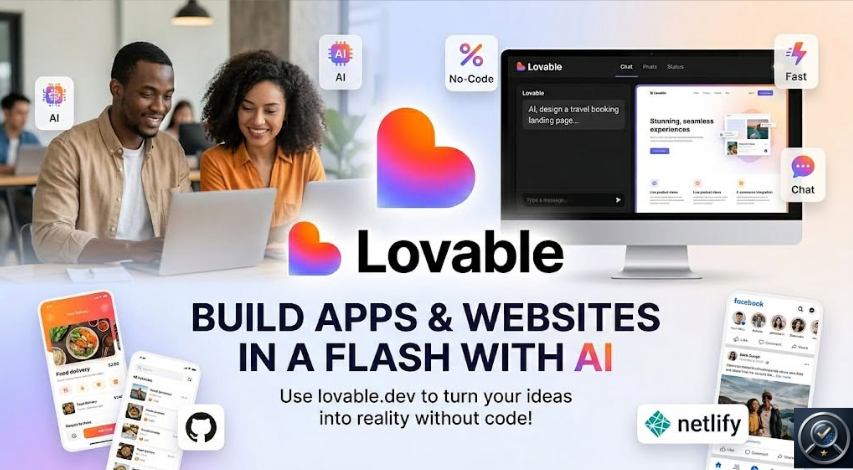
Lovable is an AI-powered full-stack application builder that allows users to create web applications through natural language conversations.
Instead of manually writing code, configuring infrastructure, or connecting backend services, users interact with an AI agent that translates requirements into production-ready software.
The process feels surprisingly simple.
You open the platform.
A chat window appears.
You describe what you want to build.
The AI begins constructing it.
A SaaS dashboard.
A booking platform.
A CRM system.
An internal business tool.
A customer portal.
An AI-powered marketplace.
In many cases, the first version becomes usable within minutes.
That simplicity is exactly what makes Lovable so compelling.
The platform removes the intimidating complexity traditionally associated with software development and replaces it with a familiar interface: conversation.
The First Impression: Surprisingly Human
Most AI development tools feel like coding assistants.
Lovable feels more like working with a junior product team.
This distinction is important.
When using traditional AI coding tools, users are still expected to think like developers.
They need to understand architecture.
They need to understand implementation details.
They need to understand code.
Lovable shifts the experience entirely.
You communicate goals rather than instructions.
Instead of saying:
“Create a React application with Supabase authentication and role-based access control.”
You can simply say:
“Build a platform where consultants can manage clients, schedule meetings, and track invoices.”
The AI interprets the business requirement and determines how to implement it.
This creates a dramatically different user experience.
For non-technical founders, it feels empowering.
For developers, it feels astonishingly efficient.
For product teams, it feels like skipping weeks of planning and implementation.
The best technology often disappears into the background.
Lovable achieves exactly that.
The Real Magic: Speed
Every software founder eventually discovers a painful truth:
Ideas are abundant.
Execution is expensive.
This is where Lovable becomes genuinely disruptive.
A process that once required:
- Product planning
- UI design
- Frontend development
- Backend development
- Database setup
- Deployment
can now be compressed into a matter of hours.
Not because software suddenly became easier.
But because AI absorbs much of the repetitive work.
The speed difference is difficult to appreciate until you experience it firsthand.
Traditional MVP development often takes several weeks.
With Lovable, a founder can test an idea before lunch.
This fundamentally changes startup economics.
Validation becomes cheaper.
Experimentation becomes faster.
Failure becomes less expensive.
And innovation accelerates.
For entrepreneurs operating in highly competitive markets, that speed advantage alone can be transformative.
Design Quality: Better Than Expected
One of the most common criticisms of AI-generated applications is visual quality.
Many AI builders generate interfaces that technically function but feel generic and uninspired.
Lovable performs surprisingly well in this area.
Applications generated by the platform typically follow modern design conventions:
- Clean layouts
- Responsive interfaces
- Professional typography
- Consistent spacing
- Modern dashboard structures
- Mobile-friendly experiences
The resulting products often resemble applications created by competent startup design teams.
Are they perfect?
No.
Will they replace elite product designers?
Certainly not.
But they are significantly better than what most founders could build on their own.
And for MVP validation, they are more than sufficient.
In many cases, they are genuinely impressive.
Why Developers Are Paying Attention
Many observers assume Lovable is primarily designed for non-technical users.
That assumption misses a critical point.
Some of the strongest advocates for AI-assisted development are developers themselves.
Why?
Because developers understand where time is wasted.
Modern software engineering involves enormous amounts of repetitive work:
- Authentication systems
- CRUD operations
- Dashboard layouts
- Form creation
- Database connections
- API integrations
These tasks are necessary but rarely exciting.
Lovable automates much of this process.
Developers can focus on solving meaningful business problems instead of rebuilding the same infrastructure repeatedly.
This is not about replacing engineers.
It is about increasing engineering leverage.
The best developers are not threatened by tools like Lovable.
They are empowered by them.
GitHub Integration Changes Everything
Many no-code platforms suffer from a fatal flaw:
Vendor lock-in.
The moment your project becomes successful, you discover that migrating away from the platform is difficult, expensive, or impossible.
Lovable approaches this problem differently.
Its GitHub integration allows users to synchronize projects with repositories and maintain ownership of their codebase.
This seemingly simple feature has profound implications.
It means:
- Greater flexibility
- Better scalability
- Easier collaboration
- Long-term maintainability
- Reduced platform dependency
For startups evaluating risk, this is one of Lovable’s strongest advantages.
You are not trapped.
You are building assets you actually own.
Where Lovable Truly Excels
Startup MVP Development
This is arguably Lovable’s strongest use case.
Founders can rapidly transform ideas into working products and gather real market feedback before investing heavily in engineering resources.
In today’s startup ecosystem, speed of validation often matters more than technical perfection.
Lovable optimizes precisely for that reality.
Internal Business Applications
Many organizations require software that is useful but not mission-critical.
Examples include:
- Team dashboards
- Workflow systems
- Reporting tools
- Inventory management
- Client portals
Historically, these projects were often delayed because development resources were allocated elsewhere.
Lovable dramatically lowers the barrier to building such systems.
Product Experimentation
Perhaps the most underrated advantage is experimentation.
Companies can test concepts, workflows, interfaces, and business models at a fraction of traditional development costs.
This creates a culture where ideas can be explored rather than endlessly debated.
The Limitations Nobody Should Ignore
While the excitement surrounding Lovable is justified, realistic expectations are essential.
The platform is powerful.
It is not magical.
Complex enterprise systems still require experienced engineers.
Large-scale architectures still require thoughtful planning.
Security-critical applications still require human oversight.
And as projects grow, AI-generated code may require restructuring to maintain long-term quality.
In other words:
Lovable dramatically accelerates software creation.
It does not eliminate software engineering.
Organizations that understand this distinction will extract the most value from the platform.
Those expecting fully autonomous software development may be disappointed.
At least for now.
The Bigger Picture: Why Lovable Matters
The most important question is not whether Lovable is perfect.
It isn’t.
The more important question is what Lovable represents.
For decades, software development has been one of the highest barriers to entrepreneurship.
Brilliant ideas often failed because their creators lacked technical resources.
AI is beginning to remove that barrier.
Lovable sits at the center of this transformation.
It enables founders to build.
It enables teams to experiment.
It enables businesses to innovate faster.
And perhaps most importantly, it democratizes software creation in a way that was previously unimaginable.
The history of technology is filled with tools that reduced complexity:
- Spreadsheets simplified financial modeling.
- Website builders simplified publishing.
- Cloud computing simplified infrastructure.
AI application builders may do the same for software development.
If that happens, Lovable could become one of the defining platforms of this new era.
Final Verdict
Lovable is not merely another AI coding assistant.
It is one of the clearest demonstrations yet of what AI-native software development looks like.
Its greatest strength is not code generation.
Its greatest strength is compression.
Compression of time.
Compression of complexity.
Compression of the distance between imagination and execution.
While it will not replace elite engineers anytime soon, it has already changed the economics of building software.
For founders, product teams, agencies, and innovators, that shift is enormous.
Overall Rating: 9.3/10
Strengths
✓ Exceptional speed to market
✓ Intuitive natural language workflow
✓ Strong MVP generation capabilities
✓ Modern UI output
✓ GitHub ownership and flexibility
✓ Accessible to both technical and non-technical users
Weaknesses
✗ Not ideal for highly complex enterprise architectures
✗ Requires oversight for production-scale systems
✗ AI-generated code quality can vary at larger scales
✗ Still evolving rapidly as a platform
Bottom Line
Lovable is one of the most exciting AI products in software development today.
Not because it replaces developers.
But because it empowers more people to build.
And in a world increasingly driven by software, that may be one of the most important technological shifts of the decade.